
Neutron Star Probes of Axions
Axions are hypothesized particles that can both resolve the Strong CP problem and constitute dark matter. A property of axions that makes it possible to detect them is that they can convert to detectable photons in strong magnetic fields. And the stronger the better! The strongest magnetic fields in the universe reside around neutron stars. Some neutron stars possess magnetic fields billions of times stronger than the strongest stable magnetic fields we can generate on Earth! Much of my recent work has focused on searching for signals of axions from pulsars, rapidly-rotating neutron stars. My work has identified novel axion production mechanisms in pulsars (PRD), produced world-leading constraints on axions (PRL), proposed a new mechanism to explain fast radio bursts (APJL), predicted the formation of axion clouds around neutron stars (PRX), and proposed pulsar-sourced axion signals that can be detected in the lab (PRD).
More recently, I have been investigating the physics of magnetars—ultra-magnetized neutron stars that, while sharing some similarities with pulsars, form a qualitatively distinct class of objects. For instance, in magnetar-strength fields, the fundamental QED interactions are dramatically modified. In recent work, my collaborators and I studied a class of magnetar models (shown in the figure), and predicted radio and millimeter signals of axion dark matter from the Galactic Center magnetar J1745-2900 (PRD). A key takeaway from our paper: the clock is ticking for detecting axions from this source. The magnetar is unusually dormant right now, but once it becomes active again, the axion signal will be much harder to observe.
"Collisionless" Self-interacting Dark Matter
A compelling solution to many galactic-scale tensions between the Lambda-CDM model and observations is to allow for self interactions between dark matter particles. This so-called self-interacting dark matter (SIDM) paradigm has received a lot of attention in the last couple of decades. In the standard treatment, SIDM dynamics are governed by particle collisions. However, we have numerous examples in nature of particle dynamics being determined not by collisions, but by collective effects.
[Enter plasma physics] Standard Model plasmas often operate in the collisionless regime, where particle dynamics are governed not by direct collisions but by collective electrostatic and electromagnetic interactions. What if dark matter behaved the same way?
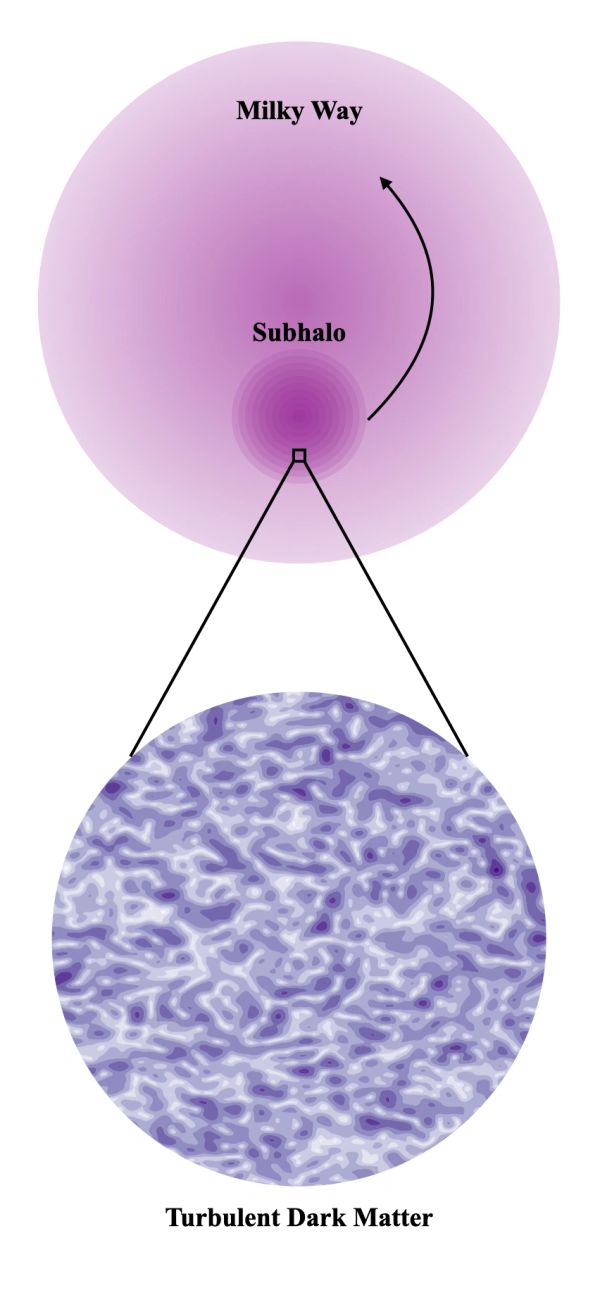
Recently, my collaborators and I have been exploring particle models in which dark matter forms a weakly interacting plasma. In a recent paper (arXiv:2511.15810), we showed that even extremely small charges can have dramatic consequences for cosmic structure formation. In a recent paper (arXiv:2607.27312), my collaborators and I studied the evolution of dark subhalos as they orbit through the Milky Way. This environment naturally triggers plasma streaming instabilities that can significantly reshape the subhalo population, potentially even leading to the evaporation of low-mass subhalos.